
Search News
Industry Portal
Hot Articles
- How to Evaluate an NDT Inspection Company for Amusement Ride Safety ComplianceChoose an NDT inspection company for amusement ride safety compliance with proven expertise, risk-based methods, clear reporting, and reliable corrective-action support.
- How to Evaluate Ski Resort Lift Suppliers for Capacity, Terrain, and Lifecycle SupportChoose a ski resort lift supplier with confidence: compare capacity, terrain resilience, wind performance, safety planning, and lifecycle support for smarter investments.
- Amusement Ride Dynamics: How Engineers Control G-Forces, Jerk, and Rider ComfortAmusement ride dynamics explained: see how engineers manage G-forces, jerk, restraints, braking, and testing to deliver safer, smoother rider comfort.
Popular Tags
How roller coasters balance thrill, uptime, and cost
auth.
Time
Click Count
For operators, investors, and engineering teams, roller coasters are not just headline attractions. They are revenue-critical systems where thrill, uptime, and cost must stay aligned.
A successful roller coaster delivers strong guest demand, high daily availability, predictable maintenance, and controlled lifecycle spending. In global leisure projects, that balance often decides profitability.
TALS tracks this balance through biomechanics, electromechanical design, safety compliance, and throughput intelligence. The goal is simple: maximize sensation without sacrificing reliability or financial discipline.
Why roller coasters require different decisions in different operating scenes
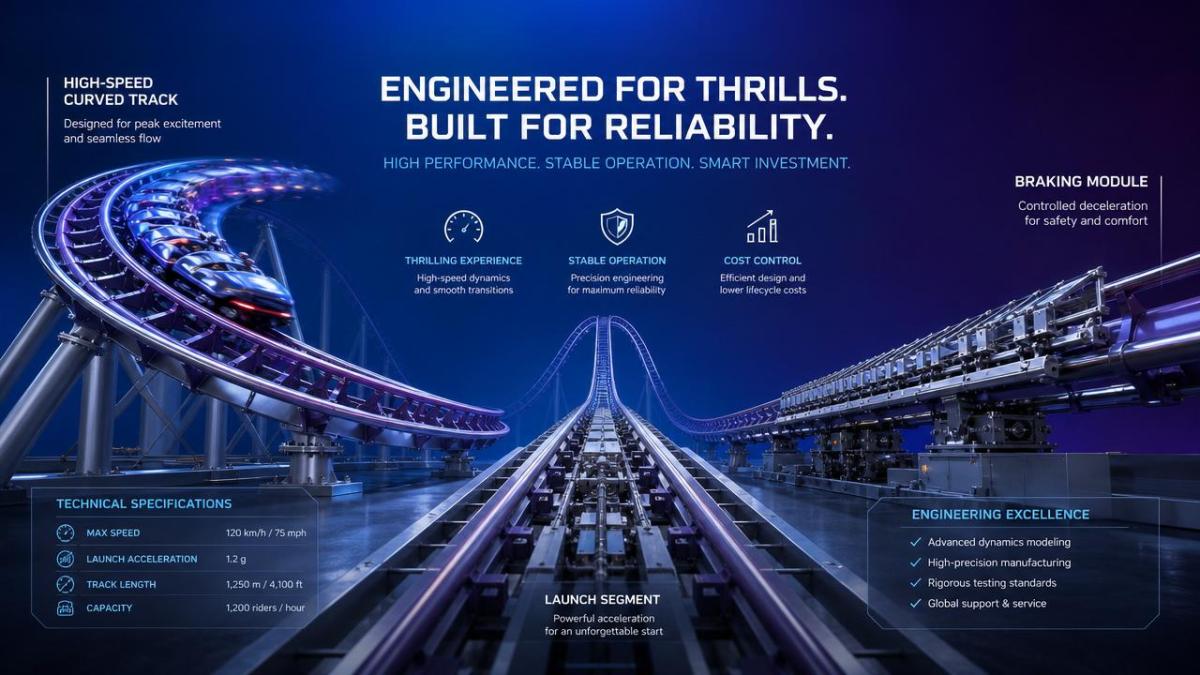
Not every roller coaster serves the same business environment. A destination park, an indoor mall venue, and a seasonal tourism site face very different constraints.
The best roller coasters are not always the tallest or fastest. They are the rides whose engineering choices fit climate, audience mix, staffing depth, and expected operating hours.
That is why scene-based planning matters. Launch technology, braking architecture, track profiling, train count, and redundancy strategy should match the actual use case.
Scene 1: Destination parks need roller coasters that combine signature thrill with durable uptime
Large destination parks usually depend on roller coasters as anchor assets. These rides shape marketing, attendance peaks, social media visibility, and guest itinerary flow.
In this scene, thrill intensity matters, but uptime matters more. A marquee roller coaster with chronic downtime can damage premium pricing and reduce in-park spending.
Key judgment points
- Can the launch or lift system support repeated peak-cycle operation?
- Does the block zone design protect throughput during minor stoppages?
- Are trains easy to inspect, reset, and return to service quickly?
- Is the ride profile thrilling without pushing unnecessary structural fatigue?
LSM launch roller coasters can create strong guest appeal. However, launch energy demand, inverter complexity, and thermal loads require disciplined power and cooling planning.
For major parks, redundancy in sensors, train positioning, and brake verification often brings better returns than chasing one more record-breaking element.
Scene 2: Regional and seasonal parks need roller coasters with simpler maintenance economics
Regional parks often face compressed operating seasons, variable weather, and smaller technical teams. Here, the right roller coaster must be exciting yet forgiving in maintenance routines.
A lower-complexity system can outperform a more advanced model if it shortens inspections, lowers spare parts dependency, and reduces specialist intervention.
Core fit criteria
- Straightforward restraint systems with fewer failure points
- Brake assemblies that are easy to access and verify
- Track layouts that reduce extreme wear at transition hotspots
- Standardized components with stable replacement lead times
For this scene, roller coasters using proven lift systems and conservative train dynamics may produce stronger long-term value than highly customized concepts.
The operational objective is not maximum novelty. It is dependable opening-day readiness across changing conditions and shorter annual maintenance windows.
Scene 3: Indoor and mixed-use developments need roller coasters optimized for control and integration
Indoor attractions operate inside tight footprints, strict noise envelopes, and shared building systems. In this scene, roller coasters must integrate with architecture as much as with mechanics.
Acceleration, vibration transmission, evacuation routes, smoke control interfaces, and energy peaks all affect feasibility. Compact design discipline becomes a financial issue.
What matters most indoors
- Precise dynamic load modeling for structure interfaces
- Controlled acoustics from wheels, launches, and brakes
- Efficient evacuation planning within enclosed geometry
- Close synchronization with media, lighting, and show control
Indoor roller coasters benefit from careful heartline shaping and smooth transition design. Better rider comfort lowers complaints while supporting repeat ridership.
In these projects, the best result often comes from reducing hidden interface risks, not from increasing top speed or inversion count.
How thrill, uptime, and cost differ across roller coaster scenes
This comparison shows why roller coasters should not be judged by spectacle alone. Context changes the winning specification.
Practical design choices that improve roller coaster economics
Several technical decisions have outsized influence on lifecycle value. These choices affect inspection labor, spare consumption, energy use, and queue performance.
High-impact decisions
- Choose track geometry that limits unnecessary wheel and rail wear.
- Use brake systems with clear verification logic and fast reset procedures.
- Design maintenance access before finalizing scenic or structural interfaces.
- Model train dispatch intervals against realistic staffing levels.
- Deploy condition monitoring for vibration, temperature, and cycle-based wear.
Roller coasters that support predictive maintenance usually create stronger uptime. Early detection of bearing issues, restraint drift, or launch anomalies prevents bigger shutdowns.
Passenger throughput also matters. A thrilling roller coaster with poor station efficiency can underperform financially despite high public interest.
Common misjudgments when selecting or upgrading roller coasters
One common mistake is overvaluing peak thrill metrics. Height, speed, and inversion count do not automatically create durable guest satisfaction or operating resilience.
Another mistake is underestimating inspection burden. Exotic layouts and specialized hardware can look efficient on paper but strain real maintenance teams.
Some projects also ignore queue behavior. If roller coasters lack strong loading ergonomics or dispatch discipline, hourly capacity drops fast during peak demand.
A further oversight involves standards and documentation. ASTM, EN, weld fatigue testing, NDT records, and safety validation should shape early planning, not late correction.
Next-step guidance for smarter roller coaster planning
A disciplined process starts with scene definition. Clarify whether the roller coaster must maximize destination appeal, seasonal reliability, indoor integration, or hybrid performance.
Then map technical options against five measurable indicators:
- Target thrill profile and rider comfort envelope
- Expected annual uptime and recovery procedures
- Lifecycle maintenance hours and spare strategy
- Passengers per hour under realistic staffing
- Compliance readiness for export or local approval
The strongest roller coasters are rarely accidental successes. They result from tight coordination between ride dynamics, safety engineering, guest psychology, and cost modeling.
TALS follows roller coasters through this exact lens. By connecting biomechanics, standards intelligence, uptime strategy, and throughput analysis, better decisions become easier to validate.
In today’s experience economy, the winning roller coaster is not only thrilling. It is dependable, maintainable, and commercially precise from opening day through full asset life.
Recommended News