
Search News
Industry Portal
Hot Articles
- How to Evaluate an NDT Inspection Company for Amusement Ride Safety ComplianceChoose an NDT inspection company for amusement ride safety compliance with proven expertise, risk-based methods, clear reporting, and reliable corrective-action support.
- How to Evaluate Ski Resort Lift Suppliers for Capacity, Terrain, and Lifecycle SupportChoose a ski resort lift supplier with confidence: compare capacity, terrain resilience, wind performance, safety planning, and lifecycle support for smarter investments.
- Amusement Ride Dynamics: How Engineers Control G-Forces, Jerk, and Rider ComfortAmusement ride dynamics explained: see how engineers manage G-forces, jerk, restraints, braking, and testing to deliver safer, smoother rider comfort.
Popular Tags
ASTM F2987-26 Takes Effect for LSM Coasters
auth.
Time
Click Count
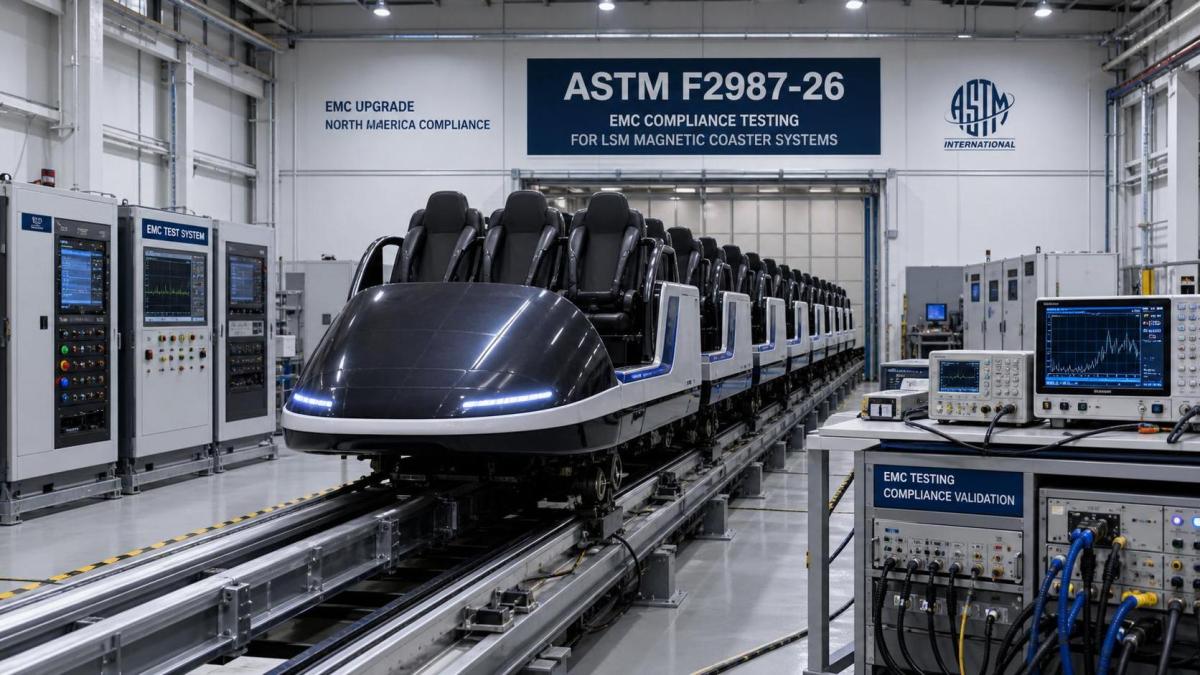
As of July 13, 2026, ASTM F2987-26 has formally come into force in the United States, raising EMC immunity testing requirements for LSM launched coasters from the previous Class B level to IEC 61000-4-30 Class A. For suppliers, exporters, testing partners, and buyers involved in LSM systems entering the North American market, this is not just a technical revision: it directly affects compliance preparation, certification timing, testing cost, and delivery scheduling.
What the new requirement changes
The confirmed change is that ASTM F2987-26 became mandatory from 00:00 on July 13, 2026. Under the new standard, the EMC immunity test requirement for LSM launched coasters has been upgraded from the former Class B level to IEC 61000-4-30 Class A, with a requirement that controller voltage fluctuation remain within +/-0.5% under full operating conditions.
The information provided also indicates that this revision materially increases testing costs and certification lead times for Chinese LSM systems exported to the North American market. Manufacturers that did not prepare high-precision EMC laboratory capability in advance may face delivery delays.
Where the pressure is likely to appear first
Export-facing system manufacturers
From an industry perspective, manufacturers supplying LSM systems to North America are likely to feel the impact first because the revised standard changes the compliance threshold tied to market entry. The main pressure points are expected to be test preparation, technical file alignment, certification scheduling, and delivery planning. What deserves closer attention is whether existing test reports, technical documents, and project submissions still match the upgraded Class A requirement.
Testing and certification coordination
Testing and certification-related parties may also be affected because the move from Class B to Class A changes the depth and precision expected in EMC verification. Analysis shows that companies will need to pay closer attention to test arrangements, report readiness, and the availability of laboratories capable of supporting higher-precision verification under full operating conditions. Where certification is linked to shipment or project acceptance, any mismatch between documentation and the new requirement could affect project timelines.
Procurement and project delivery teams
Buyers, project procurement teams, and delivery coordinators may need to reassess supplier readiness. The reported increase in testing cost and certification duration means the practical impact may show up in bid evaluation, supplier qualification review, contract timing, and delivery milestones. For procurement functions, the immediate issue is less about product description and more about whether supporting compliance evidence can be produced on time.
After-sales and project handover interfaces
For teams responsible for installation support, commissioning coordination, or post-delivery service, the main concern is traceability of compliance records. If a system reaches a late-stage project checkpoint without updated EMC documentation aligned with ASTM F2987-26, handover sequencing may become more complicated. Observably, this places more weight on document control and cross-team coordination than before.
What companies should review now
Check whether current compliance files still align
Analysis shows that companies should first review whether existing EMC test reports, technical specifications, and submission materials were prepared against the former Class B framework or can support the Class A requirement now in force. This is especially relevant for projects already in quotation, certification, or delivery preparation stages.
Reassess certification timing in active orders
Because the provided information points to longer certification cycles, companies should pay closer attention to the timing relationship between testing, certification, shipment, and customer acceptance. It is more appropriate to understand this as a scheduling risk that can move into contract execution if compliance review is left too late.
Verify laboratory and supplier capability
Where manufacturers depend on external testing resources or upstream technical partners, current attention should focus on whether those resources can support the upgraded precision requirement under full operating conditions. The issue is not only technical performance, but also whether laboratory capability and supplier readiness can keep pace with delivery commitments.
Watch for changes in market-facing documents
Observably, companies should also monitor how the new requirement appears in tender documents, technical bid alignment, customer compliance checklists, and project acceptance materials. The input does not provide detailed enforcement language beyond the confirmed standard change, so firms should treat downstream document updates as an area requiring continued verification rather than assume a uniform market practice.
How this should be read at this stage
Analysis shows that this development is best understood as a rule already in force rather than a preliminary policy signal. At the same time, the market impact still needs observation at the execution level. What deserves closer attention is how certification expectations, documentation standards, and project review practices translate the new ASTM F2987-26 requirement into day-to-day procurement and delivery decisions.
It is also more appropriate to understand this as a compliance tightening with commercial consequences, especially for Chinese suppliers targeting North America. The confirmed facts already point to higher testing cost, longer certification lead time, and delivery risk for manufacturers that did not prepare high-precision EMC capability early enough. Beyond that, further conclusions should remain cautious until more execution feedback becomes visible.
Why the signal matters beyond the test bench
In practical terms, the value of this update lies in its immediate relevance to market access and delivery reliability. The change does not simply revise a technical benchmark; it shifts the compliance baseline that can influence export preparation, buyer review, certification sequencing, and project scheduling. Current evidence supports reading it as an implemented standards change with direct operational implications, while the full extent of market adjustment still warrants continued observation.
Basis of this article and what still needs verification
This article is generated based on the user-provided news title, event date, and event summary. For developments of this type, relevant source categories usually include official notices, regulator publications, trade or customs authority information, industry association releases, standards organization documents, and reporting by established industry media.
A specific official source link was not provided in the input, so the precise official reference still needs to be verified on an ongoing basis. Further observation is also needed on detailed enforcement wording, certification interpretation, tender document updates, industry feedback, and how companies implement the requirement in live projects.
Recommended News