
Search News
Industry Portal
Hot Articles
- How to Evaluate an NDT Inspection Company for Amusement Ride Safety ComplianceChoose an NDT inspection company for amusement ride safety compliance with proven expertise, risk-based methods, clear reporting, and reliable corrective-action support.
- How to Evaluate Ski Resort Lift Suppliers for Capacity, Terrain, and Lifecycle SupportChoose a ski resort lift supplier with confidence: compare capacity, terrain resilience, wind performance, safety planning, and lifecycle support for smarter investments.
- Amusement Ride Dynamics: How Engineers Control G-Forces, Jerk, and Rider ComfortAmusement ride dynamics explained: see how engineers manage G-forces, jerk, restraints, braking, and testing to deliver safer, smoother rider comfort.
Popular Tags
ASTM Adds EMC Immunity Test for LSM Coasters
auth.
Time
Click Count
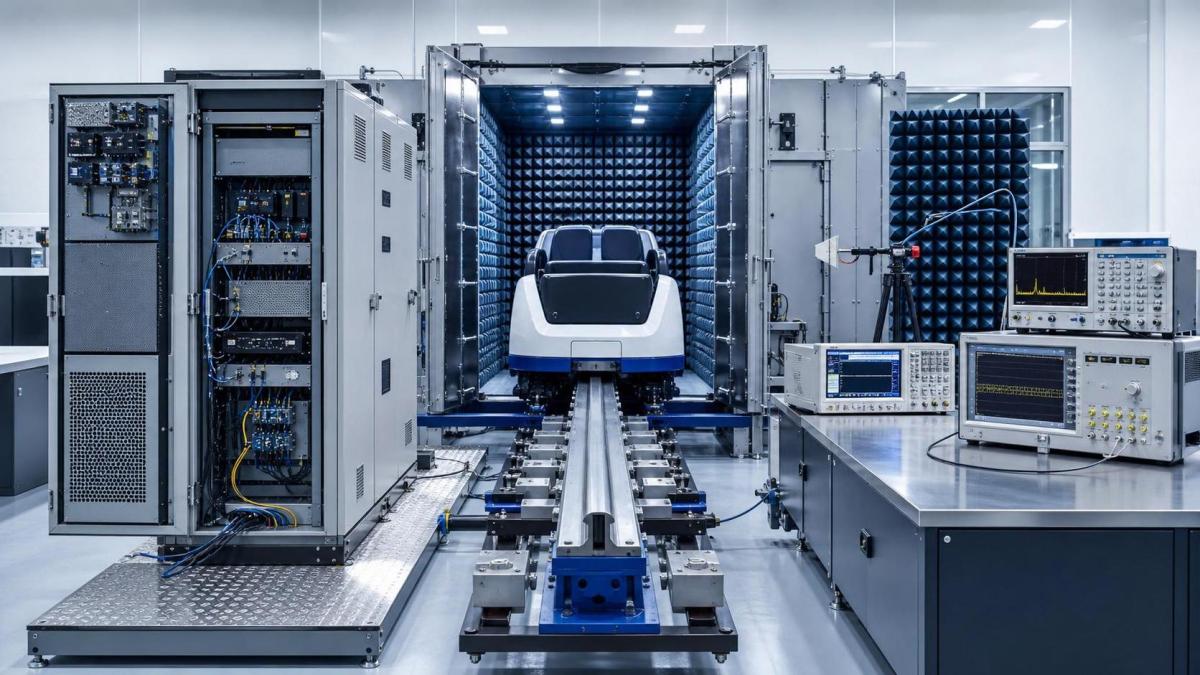
On July 10, 2026, ASTM International released the F24.12-26a revision, adding EMC immunity testing to the mandatory safety validation scope for LSM launched coasters. For Chinese manufacturers exporting LSM launch systems to the U.S., this is not a paperwork update but a new compliance step that affects testing arrangements, certification planning, delivery timing, and customer communication.
What the Revision Now Requires
According to the information provided, ASTM International issued the F24.12-26a revision on July 10, 2026. The revision brings electromagnetic compatibility (EMC) immunity testing for LSM launched coasters into the mandatory safety verification framework for the first time.
The requirement specifies an immunity threshold aligned with IEC 61000-4-3 Level 3 across the 150kHz-2GHz frequency range. The change applies to Chinese manufacturers exporting LSM launch systems to the U.S. Existing CE or UL certificates do not automatically cover this newly added item, and supplementary testing must be conducted through an A2LA-accredited laboratory.
Where the Immediate Pressure Falls
Export-facing equipment manufacturers
From an industry perspective, the most direct impact falls on Chinese manufacturers supplying LSM launch systems to the U.S. market. The main issue is that previously held CE or UL certificates are not treated as automatic coverage for this added requirement, which means compliance status must be reassessed at the product-export stage.
Testing and certification workflows
What deserves closer attention is the testing path itself. Because supplementary testing must be entrusted to an A2LA-accredited laboratory, the affected business link is not only technical validation but also laboratory selection, scheduling, document preparation, and alignment between test scope and export plans.
Project delivery and customer-side coordination
For companies already engaged in U.S.-bound projects, the change may influence delivery coordination and client communication. The practical concern is whether equipment intended for export now needs an additional verification step before acceptance or shipment-related milestones can proceed.
Procurement and downstream buyers
For purchasers and downstream project participants, the key impact is verification of compliance status rather than redesign assumptions. They need to pay closer attention to whether the supplied LSM launch system has completed the newly required EMC immunity testing under the revised standard pathway.
What Companies Should Track Now
Whether current export models are within the retest scope
Analysis shows that affected companies should first clarify which LSM launch system models intended for the U.S. market now require supplementary testing under F24.12-26a, rather than assuming existing certification files remain sufficient.
How certification documents are presented to customers
Because existing CE and UL certificates do not automatically extend to this added test item, companies should review how compliance documents are described in quotations, technical files, bid materials, and customer-facing communications. The core issue is avoiding any mismatch between legacy certificates and the revised verification expectation.
Laboratory qualification and test scheduling
Observably, laboratory qualification is now part of the compliance process itself. Since the required supplementary testing must be carried out by an A2LA-accredited laboratory, companies should confirm laboratory eligibility and arrange testing schedules in line with project timelines.
Monitoring whether implementation language evolves further
What deserves closer attention is the distinction between the confirmed rule change and any later implementation details that may shape practice. At this stage, the confirmed fact is the addition of mandatory EMC immunity testing and the need for retesting through an A2LA-accredited laboratory; any broader operational interpretation still requires continued verification.
How This Change Should Be Read
Analysis shows that this development is best understood as an actionable compliance change rather than a distant policy signal. The requirement has already been expressed in a revised standard framework, and for affected exporters the issue is immediate because existing CE or UL certificates do not automatically satisfy the new item.
At the same time, it is more appropriate to understand this as a targeted regulatory and certification development, not as a full conclusion about wider market outcomes. The current information confirms a new testing obligation, but it does not by itself establish how quickly all supply-chain participants will adjust in practice.
Why the Industry Will Keep Watching It
The significance of this update lies in its effect on compliance boundaries. It changes what must be demonstrated for LSM launch systems entering the U.S. market and places greater weight on supplementary EMC immunity verification. For affected companies, the near-term priority is not speculation but confirmation: product scope, test readiness, laboratory pathway, and customer-facing documentation all need to be checked against the revised requirement.
From a neutral industry perspective, this is more appropriate to understand as a concrete short-term compliance change with possible longer-term implications that still need observation.
Basis of This Article
This article is based on the user-provided news title, event date, and event summary. The content has been written from the confirmed information that ASTM International released the F24.12-26a revision on July 10, 2026, that EMC immunity testing for LSM launched coasters was added to mandatory safety verification, that the requirement references IEC 61000-4-3 Level 3 within the 150kHz-2GHz range, and that Chinese manufacturers exporting LSM launch systems to the U.S. must arrange supplementary testing through an A2LA-accredited laboratory because existing CE or UL certificates do not automatically cover this item.
For this type of industry update, commonly relevant source categories may include official announcements, standard organization documents, company notices, industry association releases, and reporting by authoritative trade media. A specific official source link was not provided in the input, so further verification remains necessary. Continued attention should focus on any subsequent official wording, implementation clarification, and compliance interpretation affecting export practice.
Recommended News