Search News
Industry Portal
Hot Articles
- How to Evaluate an NDT Inspection Company for Amusement Ride Safety ComplianceChoose an NDT inspection company for amusement ride safety compliance with proven expertise, risk-based methods, clear reporting, and reliable corrective-action support.
- How to Evaluate Ski Resort Lift Suppliers for Capacity, Terrain, and Lifecycle SupportChoose a ski resort lift supplier with confidence: compare capacity, terrain resilience, wind performance, safety planning, and lifecycle support for smarter investments.
- Amusement Ride Dynamics: How Engineers Control G-Forces, Jerk, and Rider ComfortAmusement ride dynamics explained: see how engineers manage G-forces, jerk, restraints, braking, and testing to deliver safer, smoother rider comfort.
Popular Tags
How to compare theme park equipment beyond price
auth.
Time
Click Count
When evaluating theme park equipment, price is only the starting point. For many projects, the real comparison includes compliance, uptime, guest flow, maintenance load, and experience quality.
A cheaper bid can create hidden costs later. Poor availability, slow spare parts, or weak safety documentation can erode returns faster than a higher purchase price ever would.
This guide explains how to compare theme park equipment beyond the quote sheet. It focuses on practical questions that support durable, safer, and more profitable decisions.
What should be compared first besides the purchase price?
Start with the full value picture. Good theme park equipment should be measured across its entire service life, not just at contract signing.
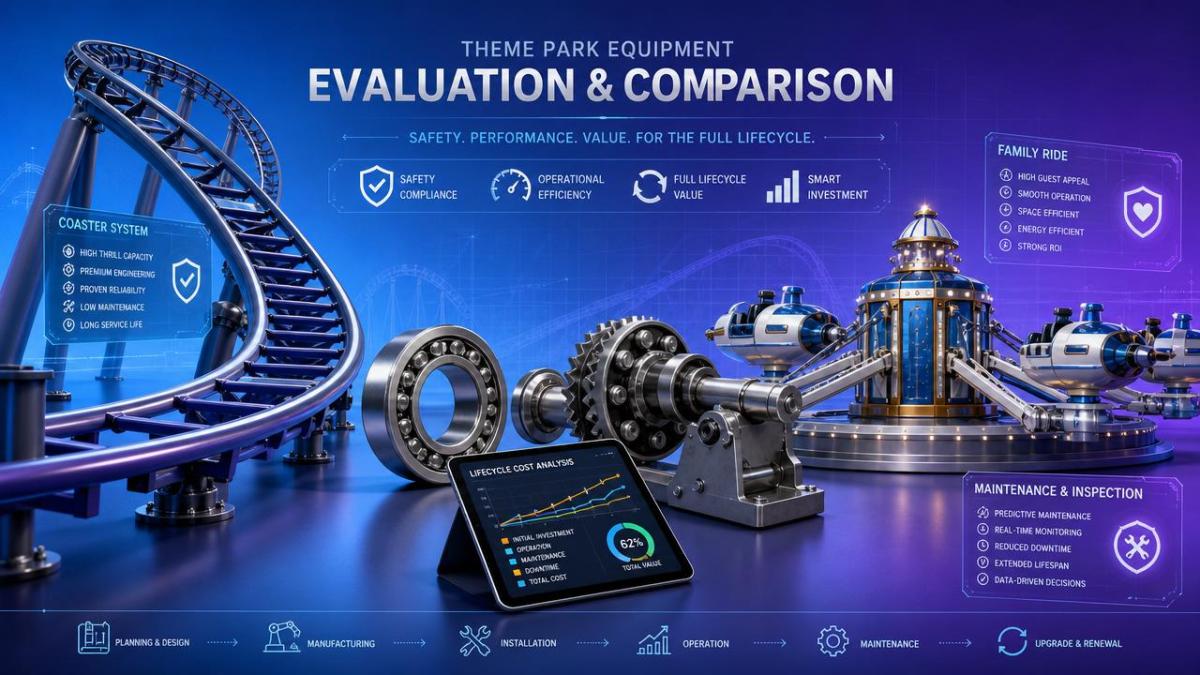
Compare these six foundations before reviewing any discount:
- Safety compliance and certification readiness
- Lifecycle operating and maintenance cost
- Throughput and queue impact
- Ride availability and downtime risk
- Guest experience quality and repeat appeal
- Supplier capability and after-sales support
For example, a launched coaster and a family dark ride serve different business goals. Their value cannot be judged by unit price alone.
The same applies to wave systems, ropeways, and non-powered adventure structures. Every category has its own performance profile, risk exposure, and maintenance rhythm.
Why does lifecycle thinking matter?
Lifecycle comparison reveals the true cost of ownership. It includes energy use, water treatment, consumables, annual inspections, replacement parts, and labor hours.
In many cases, lower-priced theme park equipment becomes more expensive after three to five years. Frequent shutdowns and component fatigue usually drive that outcome.
How do safety standards change the comparison of theme park equipment?
Safety is not a marketing sentence. It is a documented engineering system covering design, fabrication, control logic, materials, testing, and operating procedures.
When comparing theme park equipment, check alignment with ASTM, EN, local code requirements, electrical standards, and third-party inspection readiness.
What documents should be reviewed?
- Design calculations and load assumptions
- Material traceability records
- Welding procedures and NDT reports
- Control system architecture and fail-safe logic
- Emergency evacuation plans
- Commissioning and operator training records
High-value suppliers explain how redundancy works. They show what happens if a sensor fails, power drops, weather changes, or a train stops in a block zone.
For water attractions, safety comparison also includes slip resistance, filtration reliability, water chemistry stability, and rescue access design.
For ropeways, review grip systems, haul rope inspection regimes, wind limits, and station evacuation procedures. These factors affect approval and long-term trust.
How can throughput and guest flow affect equipment value?
Throughput is one of the most overlooked metrics in theme park equipment selection. It directly influences queue time, guest satisfaction, and daily revenue opportunity.
A ride with strong visual impact but weak loading efficiency may attract attention while damaging overall park circulation. Long queues also reduce food, retail, and secondary ride spending.
What throughput factors deserve attention?
- Passengers per hour under real operating conditions
- Loading and unloading speed
- Restraint design and operator workload
- Dispatch interval consistency
- Accessibility and transfer time
- Recovery speed after minor interruptions
For dark rides, scene reset timing and vehicle spacing matter. For coasters, block section design and train count determine realistic hourly capacity.
For wave pools and slides, capacity is tied to circulation routes, rider turnover, and lifeguard coverage. Poor layout can limit demand capture despite powerful hardware.
How do maintenance demands reveal the true quality of theme park equipment?
Maintenance is where promises meet reality. Reliable theme park equipment should be designed for inspection access, part replacement speed, and predictable service intervals.
Ask how many labor hours are needed weekly, monthly, and annually. Request examples of preventive maintenance schedules and major overhaul cycles.
Which maintenance issues are often missed?
- Special tooling requirements
- Spare part lead times
- Software update dependency
- Sensor calibration frequency
- Corrosion protection in humid or coastal sites
- Waterproofing and UV resistance for outdoor systems
For steel-intensive rides, coating systems and weld fatigue monitoring deserve close review. For FRP slides, surface wear and joint integrity strongly affect long-term performance.
For motion theaters, synchronization stability between media servers and motion bases is critical. A beautiful concept fails quickly if system alignment drifts often.
How should rider experience be compared when options look similar on paper?
Guest experience is more measurable than it seems. Strong theme park equipment creates emotion, comfort, clarity, and replay value without causing unnecessary fatigue.
Compare the complete ride journey, not only the peak thrill moment. The queue environment, boarding ease, sound, pacing, and exit impression all shape guest memory.
What experience indicators help comparison?
- Age and height range suitability
- Intensity versus comfort balance
- Theming integration potential
- Repeat ridership likelihood
- Weather adaptability
- Photo, retail, and storytelling extension value
A ride with moderate thrill can outperform a more extreme option if it serves wider demographics and runs more consistently across seasons.
This is especially relevant in mixed tourism destinations. The best theme park equipment supports brand identity while fitting local climate, visitor mix, and stay duration.
What supplier questions help avoid hidden risk?
The supplier matters as much as the machine. Even excellent theme park equipment can underperform if engineering support, training, and spare part response are weak.
Review installation history, reference projects, commissioning timelines, and local service capability. Ask how the supplier handles urgent failures during peak season.
Useful questions during comparison
- What is the average annual uptime across comparable installations?
- How fast can critical spare parts be delivered?
- Which components are proprietary and which are standard?
- What operator training is included after handover?
- How are software faults diagnosed remotely?
- What warranty exclusions apply in real operating environments?
Good answers are specific, documented, and testable. Vague claims about premium quality or world-class safety should not guide major investment decisions.
What common mistakes happen when comparing theme park equipment?
Several comparison errors appear repeatedly. Most come from focusing on the most visible numbers while ignoring operational detail.
- Choosing by lowest bid only
- Using supplier capacity claims without field validation
- Ignoring climate and site constraints
- Underestimating maintenance staffing needs
- Skipping evacuation and emergency scenario review
- Comparing unlike attraction categories as if they were equal
A smart comparison framework keeps thrill, safety, uptime, and commercial performance in the same decision model. That is how stronger long-term value appears.
Quick comparison table
Comparing theme park equipment beyond price leads to better operational outcomes. It helps balance safety, excitement, efficiency, and lifetime return in one clear decision path.
Before selecting any option, build a scorecard using compliance, throughput, maintenance, guest experience, and supplier reliability. Then test every proposal against the same real-world conditions.
That simple step turns equipment comparison into strategic planning. It also improves confidence that the chosen theme park equipment will perform well long after installation.
Recommended News