
Search News
Industry Portal
Hot Articles
- How to Evaluate an NDT Inspection Company for Amusement Ride Safety ComplianceChoose an NDT inspection company for amusement ride safety compliance with proven expertise, risk-based methods, clear reporting, and reliable corrective-action support.
- How to Evaluate Ski Resort Lift Suppliers for Capacity, Terrain, and Lifecycle SupportChoose a ski resort lift supplier with confidence: compare capacity, terrain resilience, wind performance, safety planning, and lifecycle support for smarter investments.
- Amusement Ride Dynamics: How Engineers Control G-Forces, Jerk, and Rider ComfortAmusement ride dynamics explained: see how engineers manage G-forces, jerk, restraints, braking, and testing to deliver safer, smoother rider comfort.
Popular Tags
Customs Tool Speeds Ride Export Filings
auth.
Time
Click Count
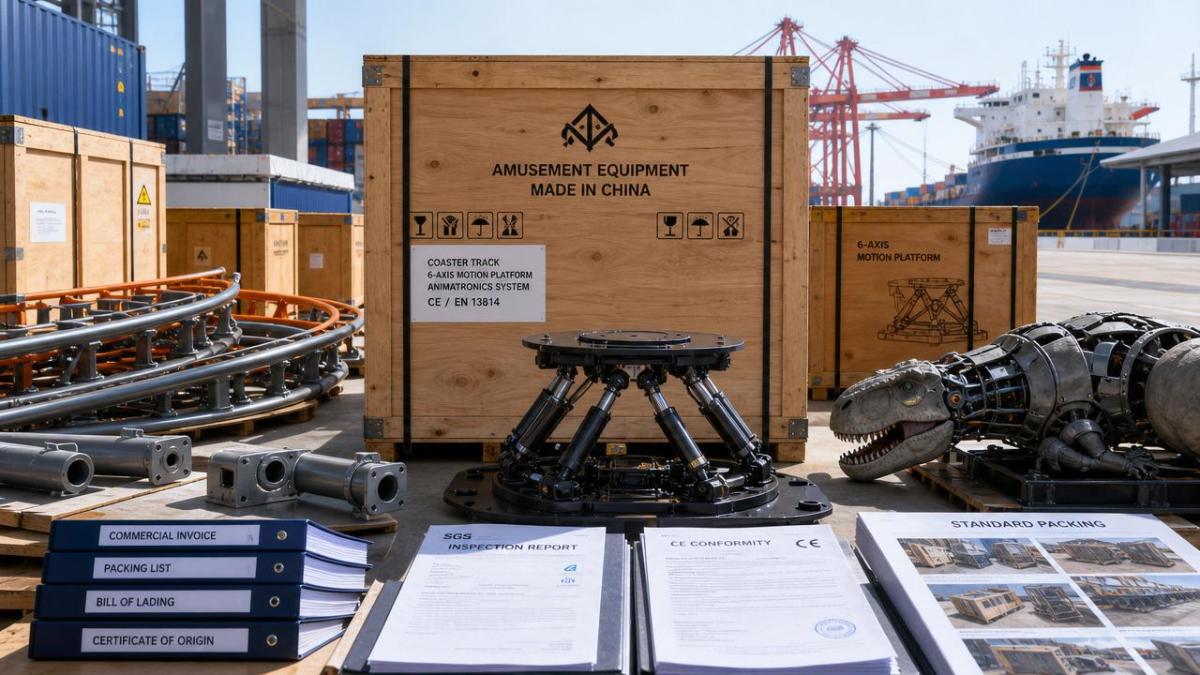
On June 10, 2026, China Customs launched an intelligent classification assistant for amusement equipment exports through the China International Trade Single Window, creating a more structured filing path around HS codes, safety standards, NDT requirements, and declaration elements. For exporters, manufacturers, testing-related service providers, and supply-chain teams handling products such as Zip Lines & Alpine Coasters, 6-DOF Motion Vehicles, and Animatronic Figures, this is worth watching because it points to a more operationally integrated customs compliance process rather than a simple interface update.
What the new filing tool now covers
According to the provided event summary, the intelligent classification assistant went live on June 10, 2026 on the China International Trade Single Window. It covers all target categories referenced in the input, including Zip Lines & Alpine Coasters, 6-DOF Motion Vehicles, and Animatronic Figures.
The system automatically matches HS codes, safety standards including ASTM F2291 and EN 13814, NDT inspection requirements, and export declaration elements. It has already been connected to major ports nationwide.
The confirmed operational result in the input is that the tool reduces pre-clearance declaration time by an average of 2.3 working days and significantly lowers the risk of returned filings and inspections caused by classification errors.
Where the operational impact is likely to appear first
Export filing moves closer to technical compliance review
From an industry perspective, exporters are likely to feel the change first because customs classification is now presented together with safety-standard references, NDT requirements, and declaration elements in one workflow. The practical implication is that filing teams may need closer coordination with engineering, documentation, and compliance staff before submission, especially where product features affect classification accuracy.
Manufacturing and documentation teams face tighter alignment needs
For manufacturers, the immediate issue is not only shipment timing but also document consistency. If the filing path now points users toward specific standards such as ASTM F2291 and EN 13814 and toward NDT-related requirements, technical files, inspection records, and declaration descriptions may need to align more closely to avoid mismatches during export preparation.
Testing and compliance service providers may be pulled in earlier
Testing-related organizations and compliance support providers may also be affected because NDT requirements are explicitly connected to the filing process in the tool description. Observably, this can shift attention toward whether supporting reports, technical statements, and related submission materials are ready before the declaration stage rather than being treated as downstream follow-up items.
Procurement and delivery planning may need adjustment
For procurement teams, project delivery coordinators, and supply-chain service providers, a shorter pre-clearance filing cycle can influence planning assumptions. Analysis shows the more relevant issue is not simply faster customs handling, but whether internal document readiness, supplier data quality, and export package completeness are now expected earlier in the delivery timeline.
Practical points companies should review now
Check whether product descriptions match classification logic
Companies handling covered ride categories should review whether product naming, configuration descriptions, and declared technical characteristics are consistent across customs filings, commercial documents, and internal technical records. The reported reduction in filing errors suggests that classification accuracy is becoming a more visible control point.
Reconcile standards and NDT materials before submission
Where the tool links filings to ASTM F2291, EN 13814, and NDT requirements, companies should pay attention to whether existing technical files and inspection materials are easy to retrieve and consistent with the declaration package. The input does not provide detailed execution rules, so this should be treated as a current compliance watchpoint rather than a finalized documentation checklist.
Revisit lead-time assumptions in export delivery plans
Because the stated average time saving is 2.3 working days before clearance, exporters and project teams may need to reassess how they build filing preparation into delivery schedules. What deserves closer attention is whether internal approval steps and supplier submissions remain the actual bottleneck even if customs-side preparation becomes faster.
Watch for evolving filing language and execution practice
The launch across major ports indicates implementation breadth, but the input does not include detailed port-by-port practice, supplementary guidance, or formal interpretation notes. Companies should therefore keep watching for further official wording, execution calibration, and any adjustments in how declaration elements are presented in daily operations.
Why this looks like an execution signal, not just a digital upgrade
Analysis shows this development is more appropriately understood as an execution signal in export compliance management for amusement equipment. The reason is that the tool does not only help users find a code; it connects classification with safety standards, NDT requirements, and declaration elements in the same process.
At the same time, it should not yet be overstated as a fully settled rule outcome beyond what has been confirmed in the input. Observably, the industry still needs to watch how consistently the tool is used in practice, whether documentation expectations become more standardized, and how companies adapt their internal filing workflows around it.
How the market may best read this development
At this stage, the event is best read as a concrete operational change that can improve filing efficiency and reduce classification-related risk for covered export categories. Its broader significance lies in bringing customs declaration, standards awareness, and inspection-related preparation closer together.
A neutral reading is that this is already a landed process change, while its wider effect on compliance routines, procurement coordination, and delivery execution still requires ongoing observation through actual use and market feedback.
Basis of this article and what still needs verification
This article is generated from the user-provided news title, event date, and event summary. For developments of this type, commonly relevant source categories may include official notices, releases from regulatory authorities, customs or trade-administration information, industry association updates, standards organization documents, and reporting by authoritative media.
No specific official source link was provided in the input, so the precise official publication path still requires further verification. It is also necessary to continue monitoring any later detail on implementation guidance, compliance interpretation, tender-document changes, industry feedback, and how companies execute the new filing process in practice.
Recommended News